

Extractive Industry Fee Increases – What CMPA Members Need to Know
26 August 2026
Significant fee increases from 1 January 2027
The Victorian Government has made the Extractive Industry (Fees) Regulations, confirming significant increases to fees applying to Victoria’s extractive industry.
The new fees will apply from 1 January 2027 and will impact the current year’s annual returns and other regulatory applications made under the extractive industries framework.
CMPA has been engaged in this process through the Regulatory Impact Statement (RIS) released in 2025. Our position was that a fairer approach should be adopted, including resetting the value thresholds used to determine fees so that the financial burden was more proportionate across operators.
While those providing responses to the RIS generally accepted the principle of cost recovery, many opposed equal or substantial increases. Industry argued that fees should better reflect business size, production levels and the level of regulatory effort, recognising that smaller operators can face a greater financial burden.
The final regulations have therefore applied smaller proportional increases to extractive industries than to minerals, while retaining the existing annual rent categories and thresholds and annual payment arrangements.
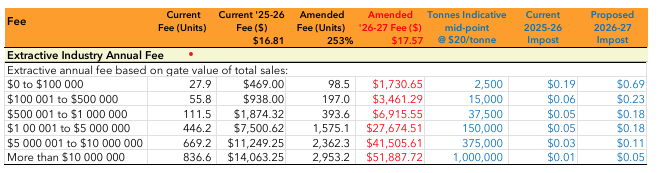
Despite this approach, extractive industry businesses will face increases of approximately 253% across the relevant fee categories.
What this means for operators
The scale of the increases will have a significant impact on businesses across the sector.
Examples based on the final fee structure include:
- A rehabilitation plan currently attracting a fee of ~$38k could increase to more than $140,000, excluding the separate fee to vary the work authority.
- For a new work authority involving blasting near a sensitive receptor and triggering an EES, the fee could increase from ~$41k to more than $150,000.
- For an operator with $10 million in sales, the fee increases from approximately $14,000 to around $41,000, estimated around $0.05 per tonne.
- For an operator with $100,000 in sales, the fee could equate to ~$0.69 per tonne.
These examples demonstrate the potential for the fee structure to place a substantially greater burden on smaller operators and businesses with lower production or sales.
Cost recovery versus industry sustainability
The Government has maintained that increased fees are necessary to move towards full cost recovery and fund regulatory activities, including rehabilitation plan assessments. However, the consultation process also highlighted concerns around:
- the viability of small quarries;
- increasing regulatory and compliance costs;
- the effect of fees on investment and operations; and
- the potential impact on the continued availability of extractive resources.
The issue for industry is therefore not simply whether regulatory costs should be recovered, but how those costs are distributed across businesses of very different sizes and operating profiles. As Ron Kerr, CMPA Honorary CEO, said “Doing business in Victoria is becoming unsustainable.”
The scale of the increases reinforces the need for operators to understand how the new fee structure will affect their individual operations, particularly where rehabilitation plans, work authority applications or variations are likely to be required.
What operators should do now
With the regulations made and fees finalised, extractive industry businesses should:
- Review their current fees and annual returns against the new 2027 fee structure.
- Identify applications or rehabilitation-plan work likely to occur during 2026–27 and account for the substantially higher regulatory fees.
- Factor increased regulatory costs into budgets and investment decisions.
- Assess the implications for quarry viability, particularly for smaller operations and businesses with lower production or sales values.
- Consider the impact of the increased fees on future projects, applications and operational decisions.
The CMPA will continue to advocate for a regulatory and fee framework that recognises the diversity of Victoria’s extractive industry and the significant contribution made by businesses
of all sizes.
Read more in CMPA’s Submission to Resources Victoria